
The Lords Industry and Regulators Committee Report into river pollution and water supply came out last week, March 2023. It includes a thorough look at the causes of river pollution with numerous stakeholders providing a wide range of evidence.

A key take-away in the report is the recommendation to adopt an holistic approach to water management. Amongst many other recommendations, the committee includes a chapter on Future Water Supply and catchment based approaches to managing river pollution (closely related to flooding) which are critical to consider together if healthy rivers and a sustainable water supply are to be secured for future generations.
To achieve this joined-up holistic approach, the committee recommend the Government sets up a National Water Strategy involving close collaboration between regulators, the industry and customers to pursue, at pace, a secure and sustainable future water supply and waste water management system.
Water supply through abstraction from rivers and groundwater, transfers from areas of relative surplus to deficit, appropriate storage to reduce times of shortage and the treatment of wastewater and discharging of non-hazardous waste into the environment are all intimately connected and pursuing these in isolation would be far less productive than adopting an holistic approach, from national to catchment scale, recommended by the committee’s findings.
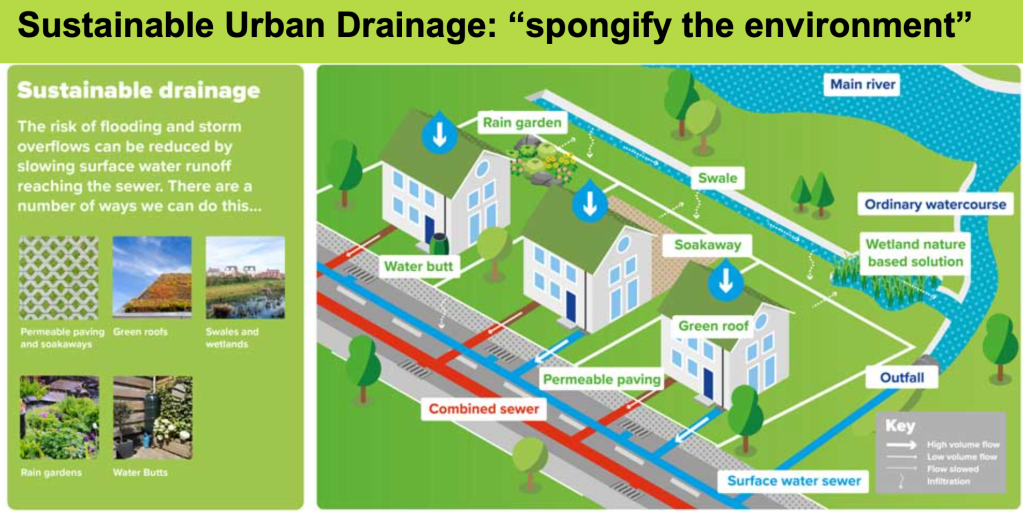
Into this picture must be added flood protection. Sustainable Urban Designs (SuDS or as Sarah Bentley CEO of Thames Water called it “spongifying” development!) and slowing the flow of runoff into rivers is crucial to include in a National Strategy, not least because a significant cause of pollution into rivers is rainfall causing uncontrolled runoff into drains overwhelming treatment works causing storm overflows.
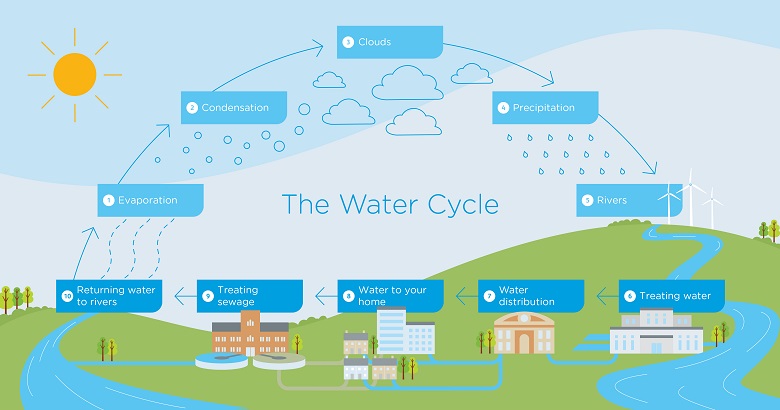
So, a fresh holistic view of our water supply and waste water treatment process and flood protection as a whole system is needed. Following a raindrop through this cycle with a school-style flow diagram of the water cycle is helpful! Many of these solutions are covered below.
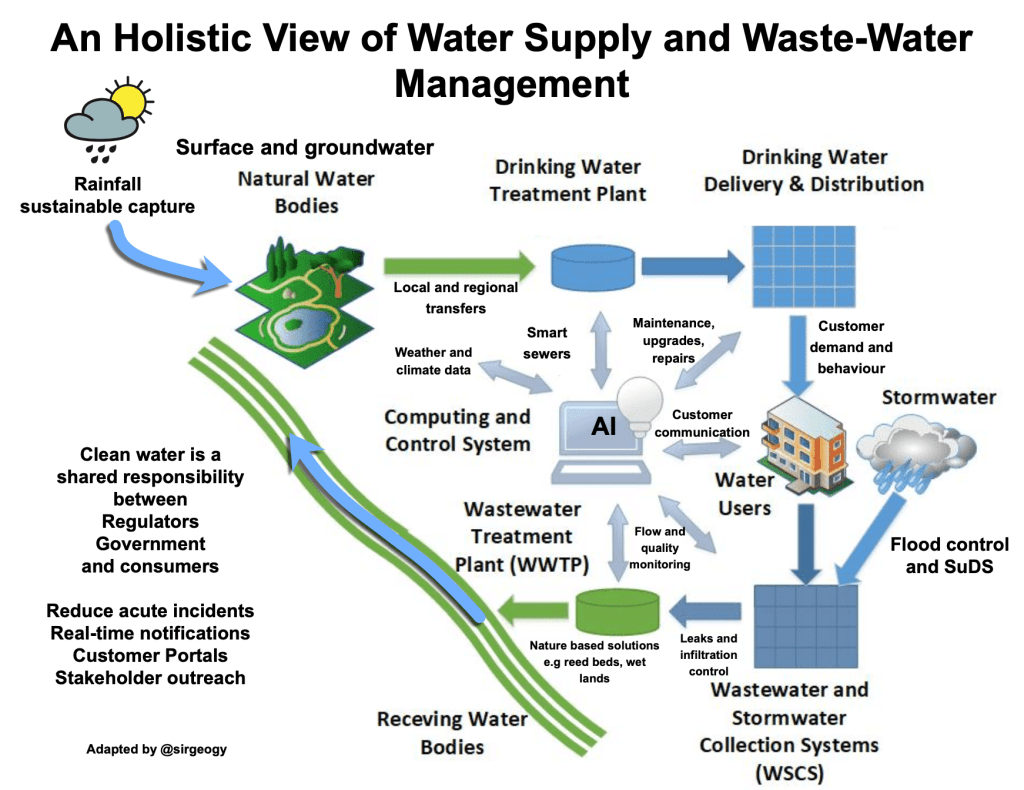
An holistic approach means connecting the start of the process, from weather and climate change drivers delivering variable amounts of rain, with the complex web of interacting systems and challenges such as climate change, water supply, biodiversity loss, agricultural productivity, flooding and human health and well being, all the way to the very end of the process, with clean waste discharging into rivers or the sea.
Solving pollution in rivers touches many other challenge that face us and therefore gives us an opportunity to design complementary solutions.
An holistic approach would therefore engage with, for example, low carbon technologies, sustainable water supply, renewable energy, increased biodiversity and health and recreational opportunities for people in combination with technology to improve waste treatment processes.
This is a summary of the Lords Committee report which includes additional data from water company plans and some observations of plans from my own catchment, the River Mole in Surrey, to complete a picture of where we seem to be going. Each specific Lords recommendation is shown inside a red box using the wording of the report. The whole post here is based on the report with numerous other sources. All references used are listed below.
I hope you enjoy my interpretation of the Lords report and find it interesting, I certainly enjoyed researching it. If you finish reading it (it’s quite long, but shorter than the original Lords report!) please do leave a constructive comment below and like my post and do the same on Twitter or Facebook. I am always happy to talk about my fantastic local river! Many thanks.

How bad is the situation?
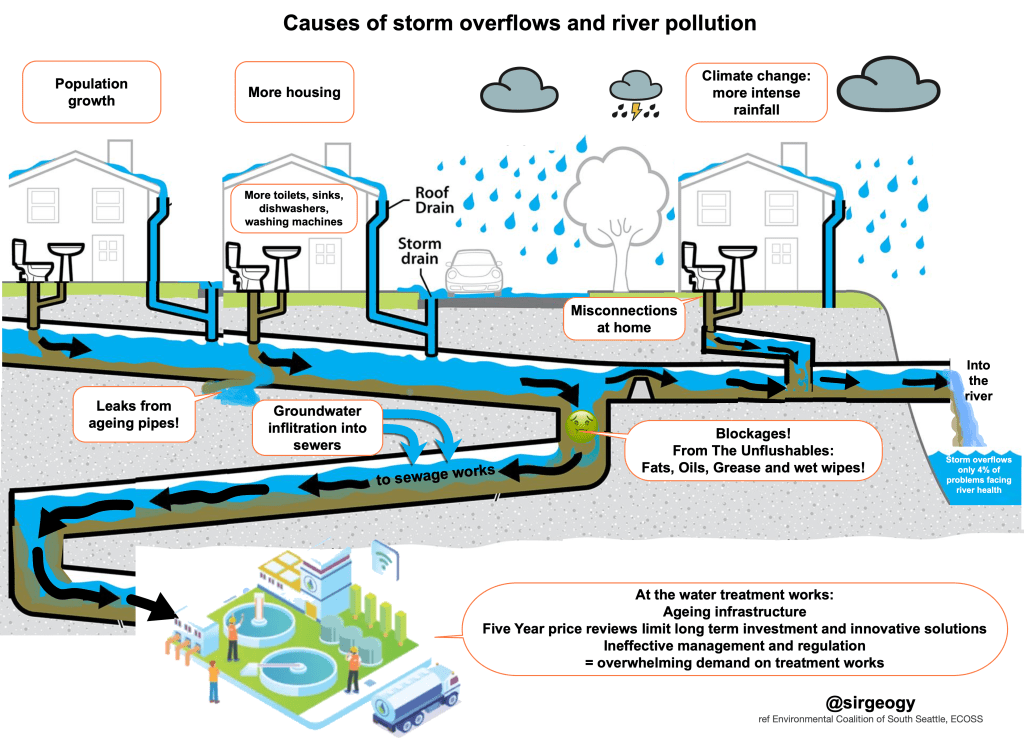
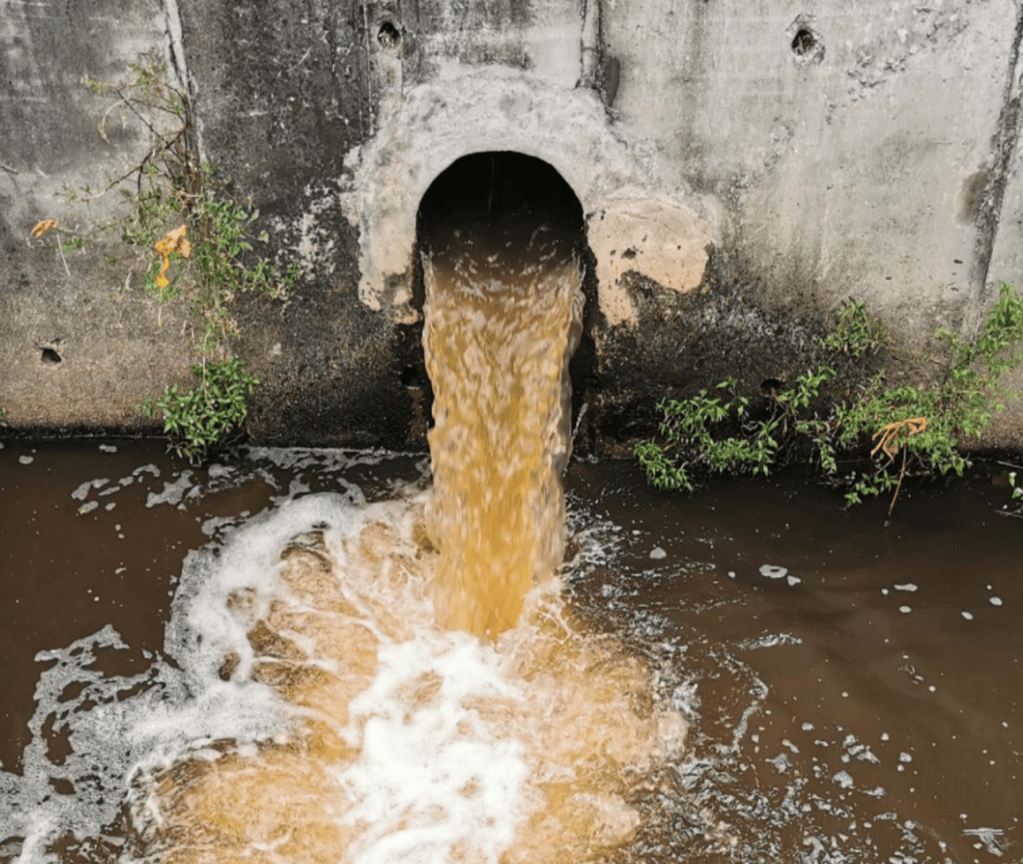
Storm overflows refer to untreated water being released into rivers from water treatment works (WWTW) or combined sewer overflows (CSOs) or pumping stations. The diagram below shows numerous causes or triggers of storm overflows but let’s look at how bad the situation is first.
The level of pollution, environmental and public health impact caused by storm overflows is somewhat debated. The Water Industry claims overflows are highly diluted and therefore have little or no environmental damage.

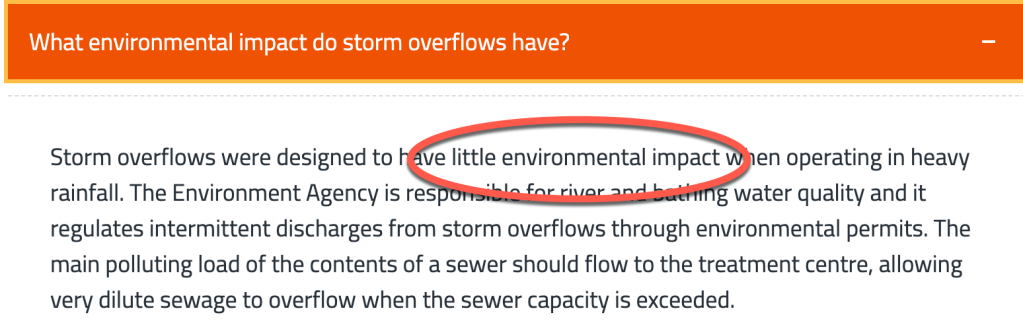
The issue for community river groups and campaigners is how to record pollution and measure damage so that levels of impact can be robustly evidenced and action triggered. Sometimes rivers that look really bad, for example covered with foam, are less polluted than seemingly clear rivers which are, on closer study, dead.

Let me pause and quickly outline the activities of our river group and the limitations of what we know. Our community group, River Mole River Watch, meets with Thames Water, Gatwick Airport water quality managers and the Environment Agency as well as local councillors and Local Authorities in an effort to forward progress towards a more healthy River Mole that can be enjoyed by local people. Mutually open and honest communication is important so we, that is the wider community, can better understand what is going on. I have found everyone I have met to be dedicated to improving the river, no exceptions. That’s it, no exceptions.


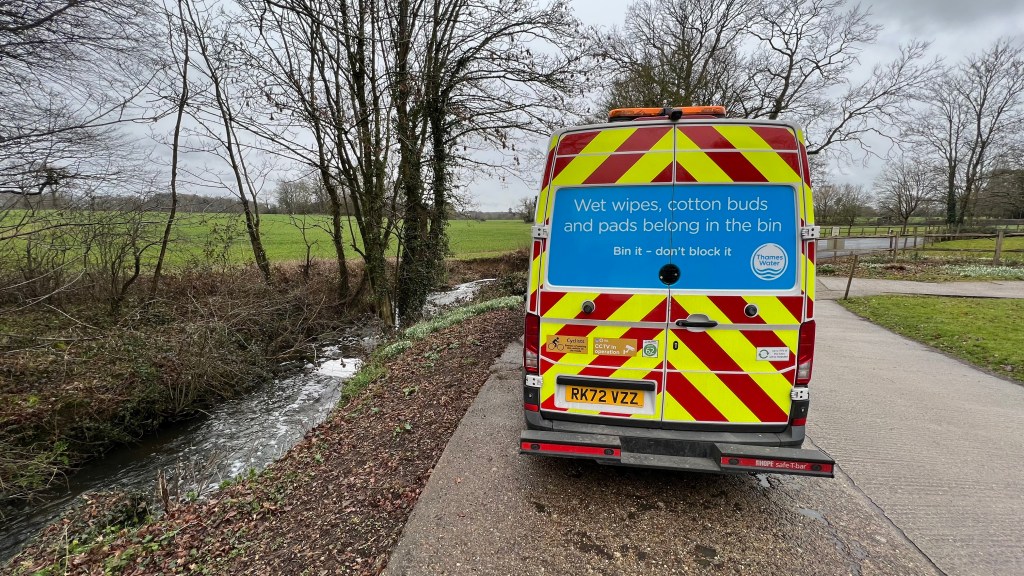
We feel that regular and honest dialogue is crucial to finding ways forward to improve our river. In particular, wider knowledge of the processes and problems faced by the various sectors is important to achieving progress at a community level. Our core regular activity is testing and monitoring stretches of river including outfalls and reporting incidents and issues as we find them. We have found our engagement with the Environment Agency (EA) as well as close cooperation with South East Rivers Trust (SERT) have been very helpful. One of our group sits on the River Mole Catchment Partnership (RMCP) along with numerous members of other stakeholders and interest groups.
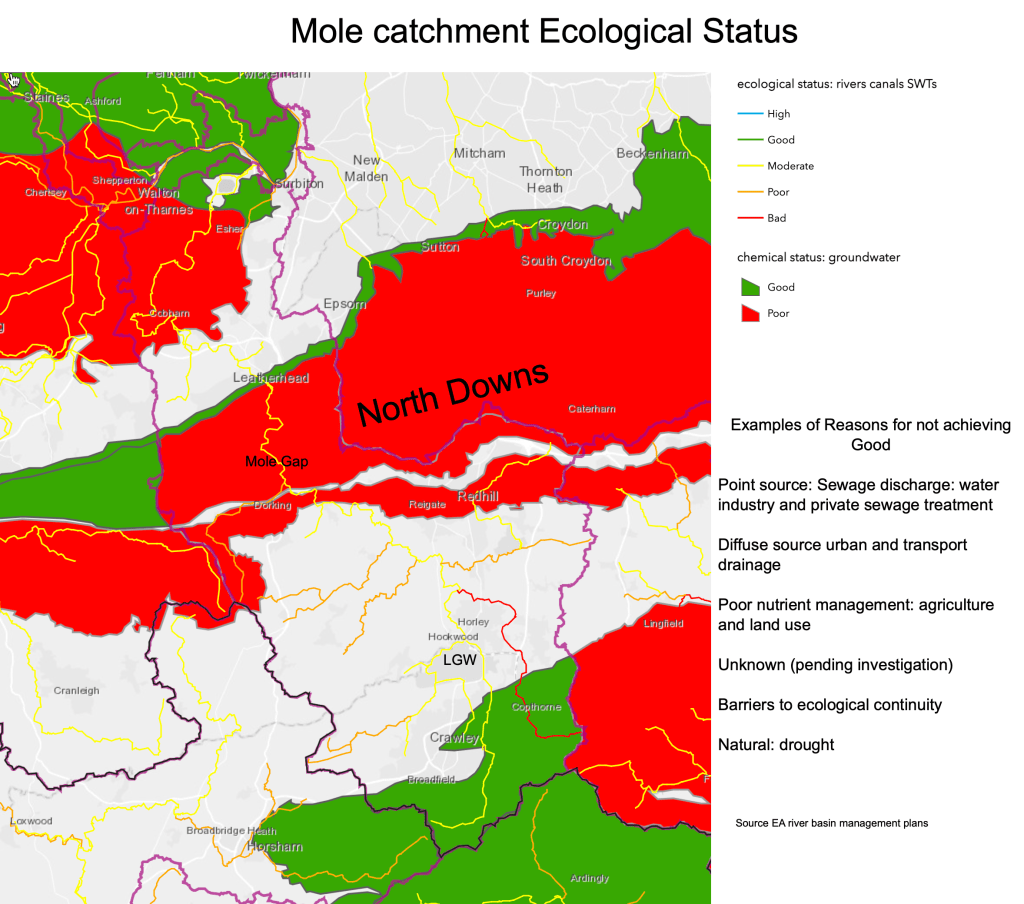
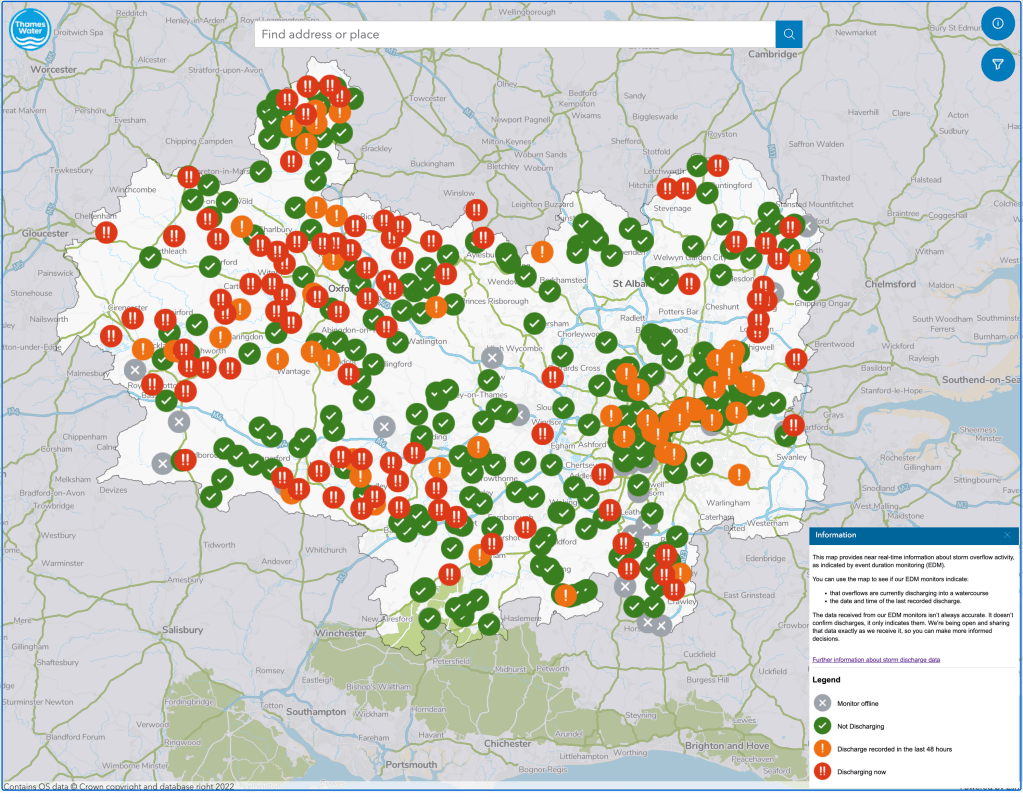
For the River Mole alone there are therefore a lot of dedicated people passionately involved with improving river health but, and this is my own opinion, I don’t think any of us really know exactly how polluted the river is at any one moment or location! Despite Thames Water’s excellent EDM map published in January 2023, there is no live data indicating real time river health. This needs to change.
Our own regular testing and monitoring of the river is still important for gauging and reporting acute incidents even if we cannot tell how “bad” the pollution actually is. If we see it, we report it, but that’s a different story.
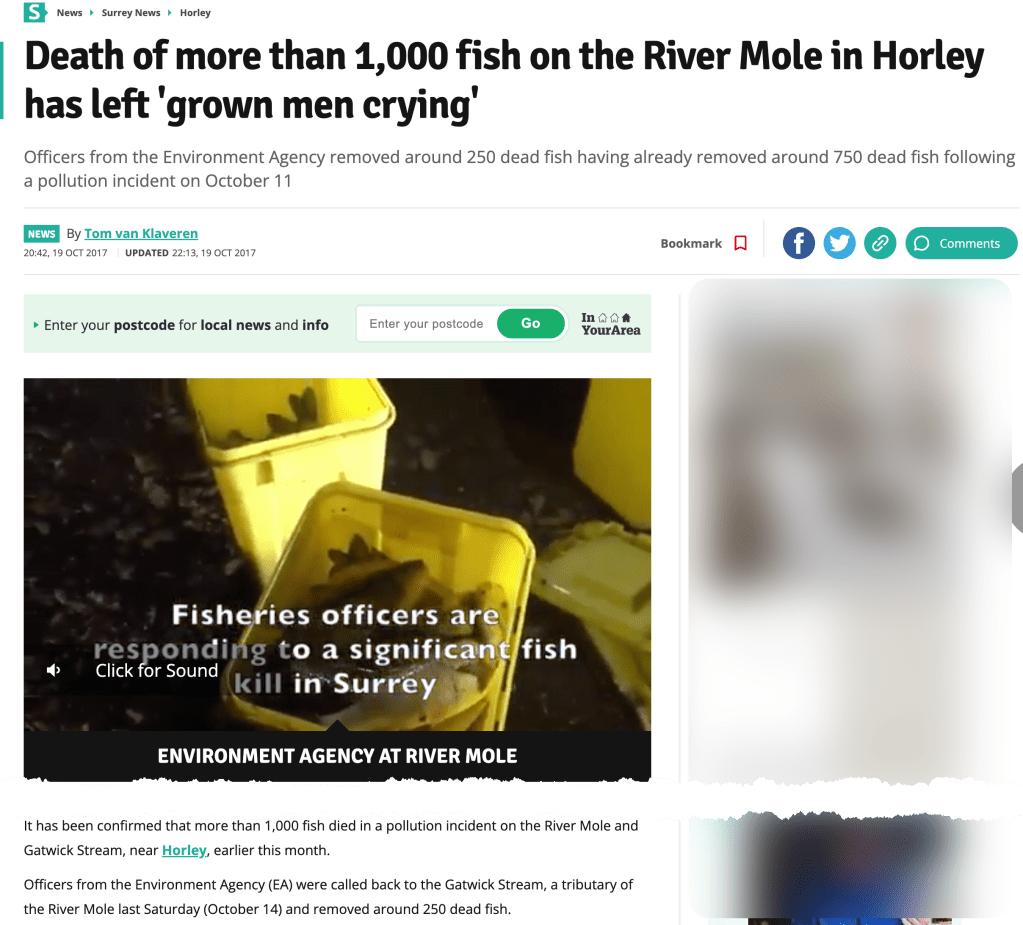
Whilst there are uncertainties over the “live” level of pollution, there is no doubt at all that raw sewage is highly polluting and if discharged into rivers has the potential to kill fish or cause longer-term damage to the ecosystem. Sadly there have been several acute incidents where this has happened on the River Mole.
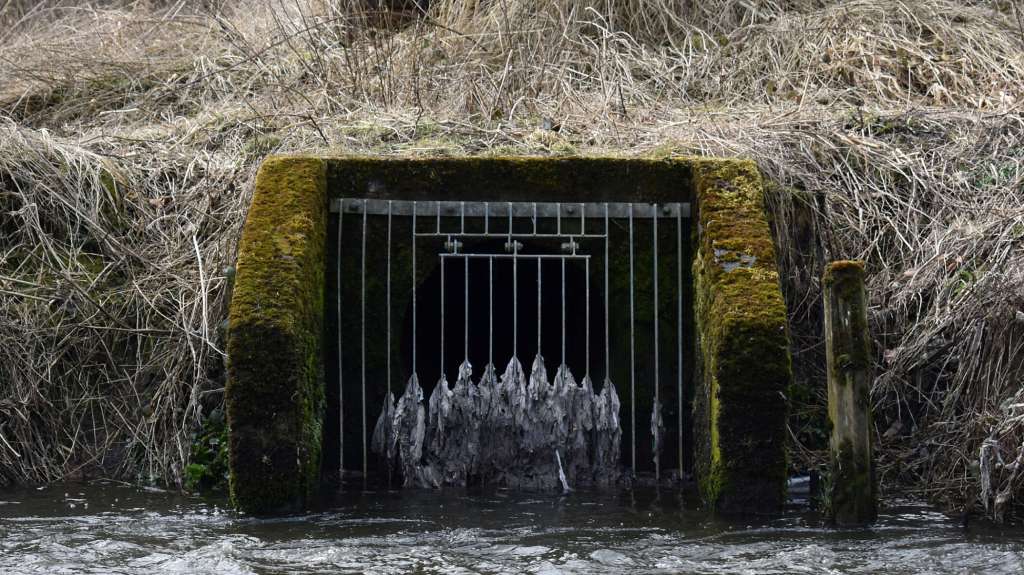
The effluent discharged from storm overflows is usually diluted by rainfall and then screened to 6mm so removing solids, toilet paper, sanitary towels etc. Many treatment plants also discharge storm sewage that has already settled in tanks to further reduce suspended solid matter. Some water companies claim this primary treatment makes storm overflows relatively harmless to the environment. Nevertheless, repeated overflows lasting days and weeks even after rainfall has ceased long ago, will be less dilute and therefore more harmful at low river flow. The environment doesn’t have time to recover from repeated discharges. Unfortunately, getting “live” evidence and data on damage to ecosystems resulting from overflows is difficult.
Further to uncertainties over levels of live pollution and measuring damage, Environment Agency data suggests storm overflows are responsible for only “4% of the problems affecting river and waterway health”. This somewhat surprising statistic means that ending storm overflows today will sadly not result in unpolluted, clean rivers tomorrow. There are numerous other causes of pollution, for example agricultural runoff, misconnections, blockages and road runoff but, as these sources of pollution are more diffuse, they are less visible to people and harder to identify and locate.
So, an awkward question might be: is it best value for money to pursue storm overflows? (that’s a question tackled later in the post).
To gauge how bad things are, it’s also worth looking at Government data that appears to show some decline in the number of “serious pollution incidents” since 2005. The chart below refers to the most serious Category 1 and 2 acute incidents such as those causing mass fish death rather than storm overflows that continue for hours, days or weeks that build up untold damage and commit river ecosystems to a slow unrecoverable death.
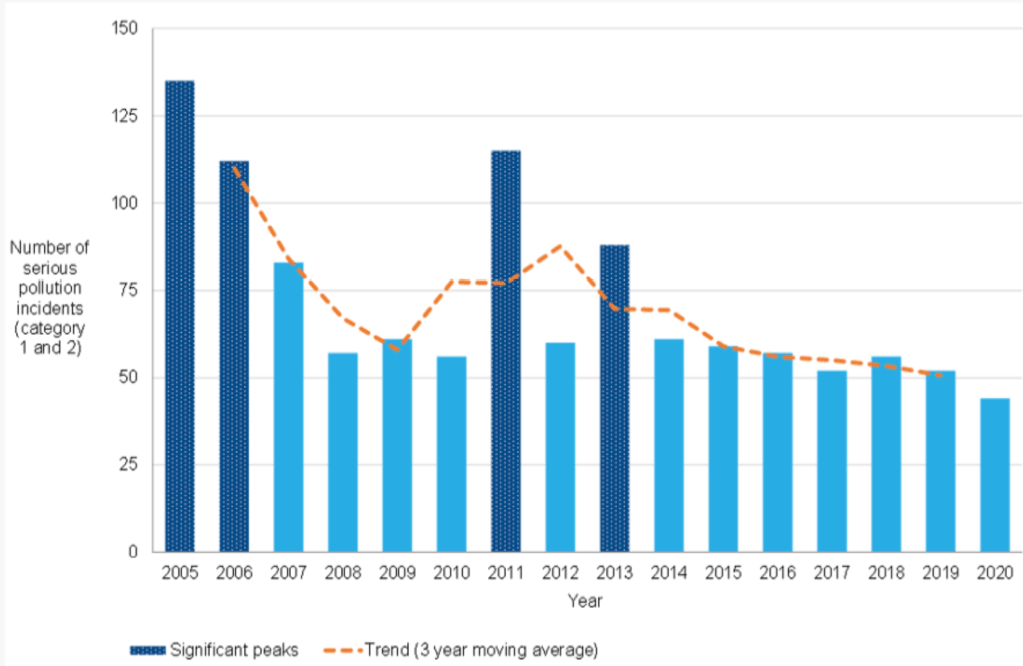
The Government Water and Sewerage Company report 2019, in any case, clearly concluded the following with regard to the trend in serious incidents:
The number of serious water quality pollution incidents from water company sewerage assets continued to be unacceptable.
There was no improvement in the number of the most serious incidents from water company sewerage and clean water assets that cause a major impact (category 1).
The high performance from United Utilities shows it is possible for water companies to have a consistent and faster trend to zero. There remains a clear need for the sector to continue to invest in reducing pollution incidents and share best practice.
https://www.gov.uk/government/publications/water-and-sewerage-companies-in-england-environmental-performance-report-2019/water-and-sewerage-companies-in-england-environmental-performance-report-for-2019
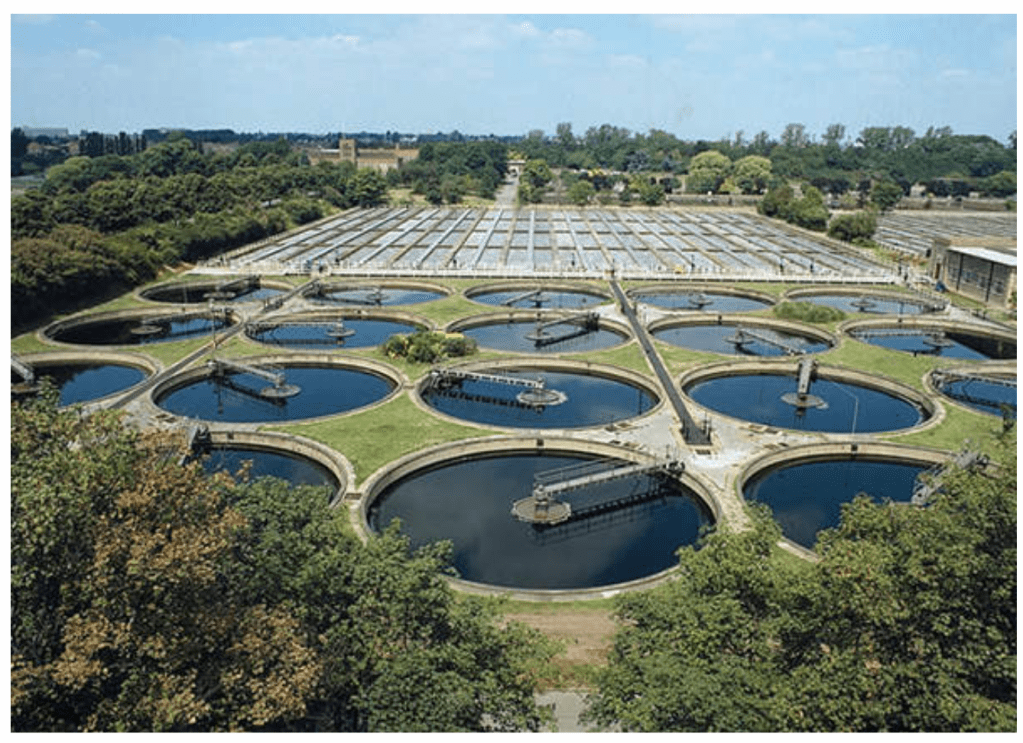
Overall then, we know that the storm overflows and river pollution situation is “bad” even if pinning down exactly how bad at a local level for a particular time is difficult given current availability of data and testing.
Now let’s deal with the direct causes of storm overflows before moving on to deeper root causes.
Causes of river pollution from storm overflows
Old sewers and ageing infrastructure: the average age of London sewers is 84 years old, the average life expectancy for a sewer is 80 years! The Water industry has been slow to identify early signs that investment was needed. Old pipes also mean more leaks and, while 51 litres per day is leaking from water company networks, the willingness of customers to reduce consumption will be reduced. We will find out later that consumer behaviour is a key area in tackling pollution. Nevertheless, companies are making better progress with leaks and most are meeting targets. However, the 2020 EA target to reduce leaks by 50% by 2050 should be seen as a minimum.
The Unflushables! Oils fats greases and wet wipes block sewers and cause overflows and back ups. These are a common cause of “hydraulic sewer flooding” which means increased pressure from blockages causes sewage to back up into peoples homes and/or properties.
Urban creep: modern housing and industrial development has caused an ever increasing cover of impermeable surfaces and more connections to the sewer network. Currently, in England, developers have the right to connect new developments to combined sewer systems, without separating foul and surface water, and without regard to the capacity of the sewer to take on a new connection. In Wales, this right was removed in 2019.
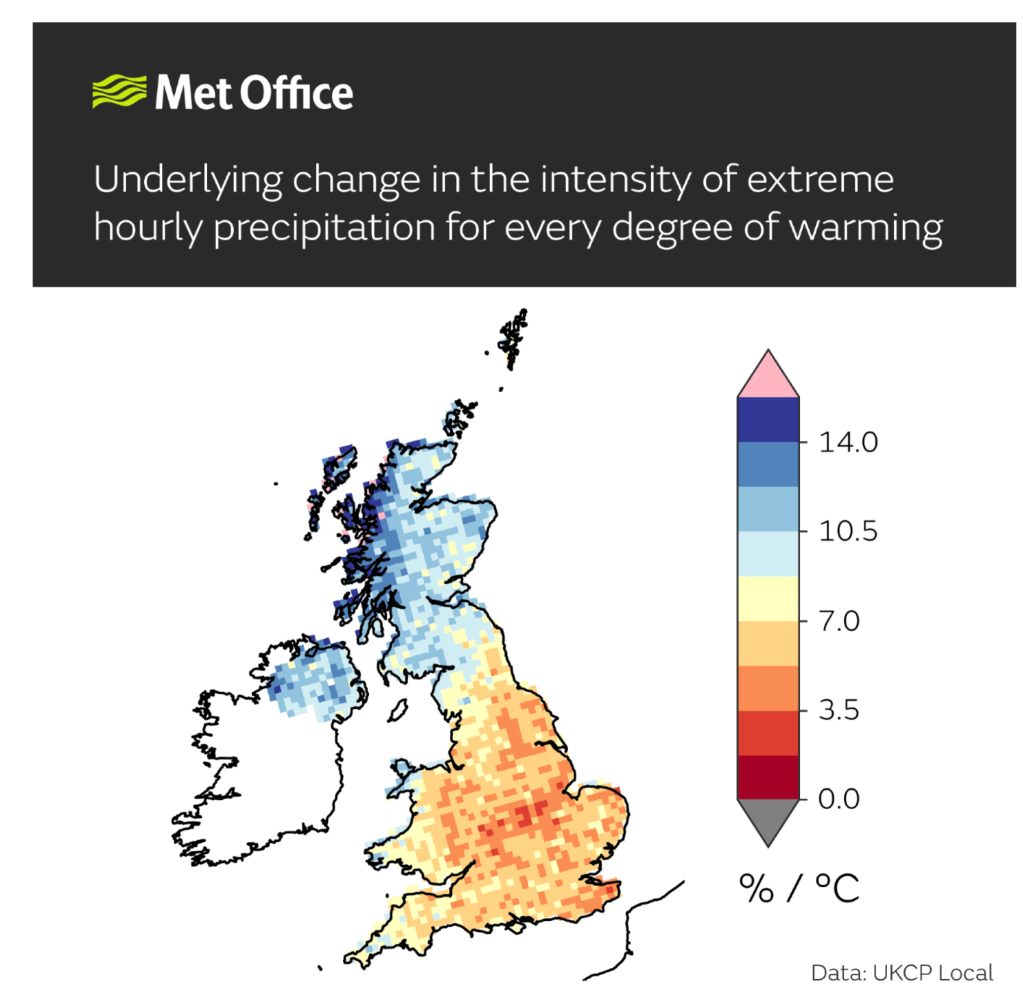
Climate change: A recent MetOffice study confirmed that rainfall is predicted to increase in intensity with every degree of warming.
Groundwater infiltration into sewers: During excessively wet winters, some areas are affected by groundwater infiltration into sewers. Excess groundwater entering the sewers can occupy a high proportion of the sewer system capacity and prevents sewage from being conveyed to the treatment works. During these conditions, some customers suffer restriction in use of their bathroom, toilet and kitchen facilities.
Ineffective management and maintenance of wastewater treatment works: Nearly a third of breaches of storm overflows resulted from inadequate maintenance of sewers. So mistakes, breaks and errors in operation can occur causing releases of untreated waste into rivers, even at times of low flow and dry weather.
Direct causes of storm overflow river pollution, then, come from acute issues like intense rainfall due to climate change and urban creep adding pressure to local treatment works. However, given investment and planning these may not have been a problem. So weak regulation of the water industry must have been an exacerbating factor.
Storm overflows appear to have crept up on regulators. The EA and perhaps even the water companies themselves, were not fully aware of the huge scale of storm overflow discharges until after 2014 when monitors (Event Duration Monitors) were routinely installed and started returning data. An alternative to this generous view is that Water Companies saw an opportunity to make more money and took it. The Lords looked at the problem of weakened regulation and how it spun-up to end with water companies polluting rivers.
Wobbly regulation and policy
Fundamental problems were identified with the relationships between Ofwat, the EA and Water Companies and their customers. This hampered identification of problems.
Conflicted Ofwat: Ofwat was found have struggled with trade offs between its functions: protecting customer bills while at the same time managing water industry investment and protecting the environment. Historically it was found to have had kept bills low at the expense of investment in future infrastructure to protect the environment for future generations.
Poor karma: The EA and Ofwat were found to have not worked particularly well together at times. Furthermore, the public were confused between the two agencies which “obscured accountability and allowed buck passing”.
Poor Policy: The Government has not given Ofwat robust guidance to balance their priorities. There is a need to strengthen language so that Ofwat is enabled to promote efficient investment that delivers “value for money for customers, society and the environment over the long-term”.
EA thousand Cuts! The Environment Agency’s funding has been cut which has seriously compromised monitoring and enforcement of breaches of permit. This led to an over-reliance on self-monitoring by water companies which is only now being addressed by private firms tasked with monitoring e.g Adler and Allen. EA penalties awarded to Water Companies for serious offences have also been insufficient to act as a robust deterrent. While penalties for companies and CEOs are now being addressed appropriately, in my opinion, prison sentences are an expensive and unnecessary trial for everyone and meanwhile, the pollution on the ground probably goes on.
Emma Howard Boyd, Chair of the Environment Agency, 2022 said: “It’s appalling that water companies’ performance on pollution has hit a new low. Water quality won’t improve until water companies get a grip on their operational performance. For years people have seen executives and investors handsomely rewarded while the environment pays the price. Company directors let this happen. We plan to make it too painful for them to continue like this. The amount a company can be fined for environmental crimes is unlimited but fines currently handed down by the courts often amount to less than a chief executive’s salary. We need courts to impose much higher fines. Investors should no longer see England’s water monopolies as a one-way bet.”
https://www.acenet.co.uk/news/industry/water-bosses-threatened-with-jail-for-serious-environmental-damage/
Short sighted: Finally, water companies themselves have struggled with long term innovation partly due to the short term 5 year Price Review time frame. The Five Year Price Review process means it is difficult to spread the cost of large schemes required to implement long term holistic sustainable environmental strategies.
Solutions to regulatory and policy woes
Competition:
The dearth of long term strategy could be fixed by opening up large scale schemes such as reservoirs and transfer schemes and investments such as SuDS (Sustainable Urban Drainage), to competition. The Thames Tideway is a good example, delivered by a third party, Tideway, at lower cost, more quickly and for better value for customers than Thames Water could achieve.

Output based regulation:
The Environment Agency currently regulates Water Companies through output based regulation. This prescribes hundreds of prescribed outputs that must be achieved. Moving to an outcomes based regulatory approach would give Water Companies the opportunity to design innovative solutions to problems. Setting nationally strategic top-level targets would allow Water Companies to design their own way to achieve them and would be more effective and environmentally friendly.
Government Coordination:
The Government needs to co-ordinate an holistic approach to water pollution by publishing a National Water Strategy that approaches water policies in a holistic way. The NWS should…
- set clear expectations in relation to the quality of the water environment and the resilience of water supplies, giving regulators clear benchmarks to work towards.
- set out clearly how the Government intends to oversee the regulators’ delivery of these expectations with a greater focus on the outcomes to be achieved.
- ensure strategically significant water infrastructure projects are designated as nationally significant infrastructure projects and can progress through the planning process in a timely manner
Solutions to pollution
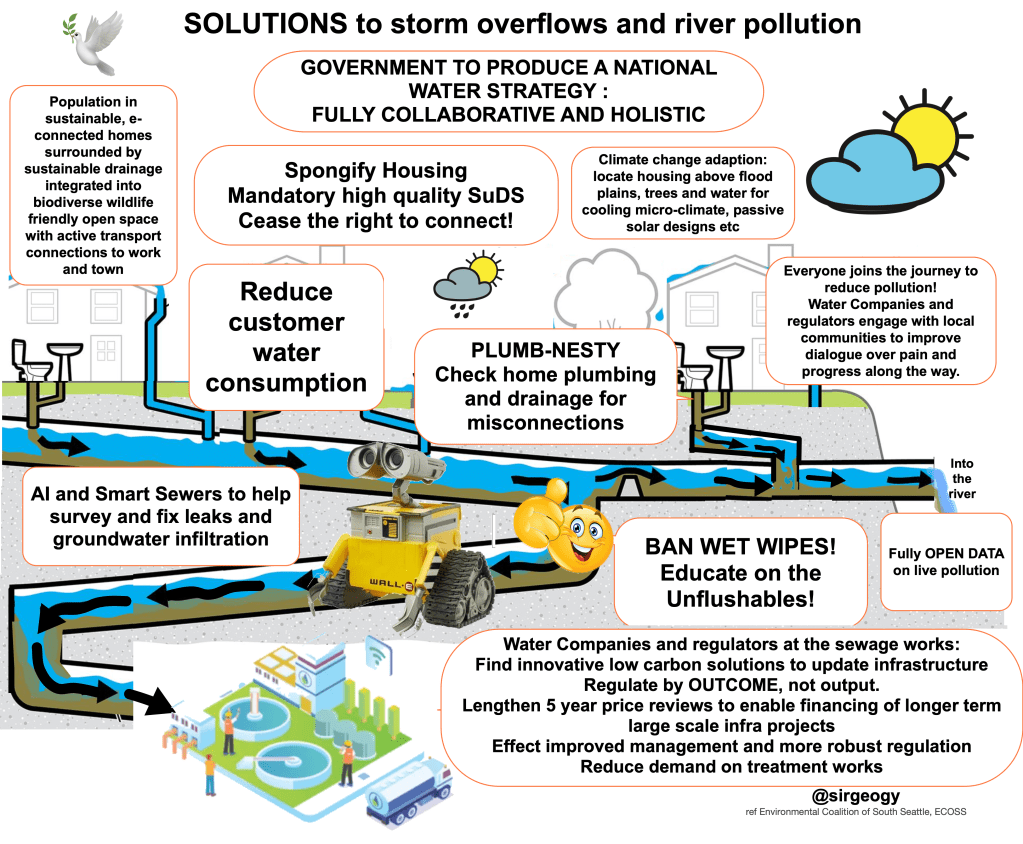
More tanks? There is a need to add capacity to treat or store more water in areas with rapidly expanding housing. Constructing more storm tanks across the whole network to capture excess water during heavy rain would cost £240 – £260 billion. However, data and AI would assist with identifying those places where this would be an effective measure.
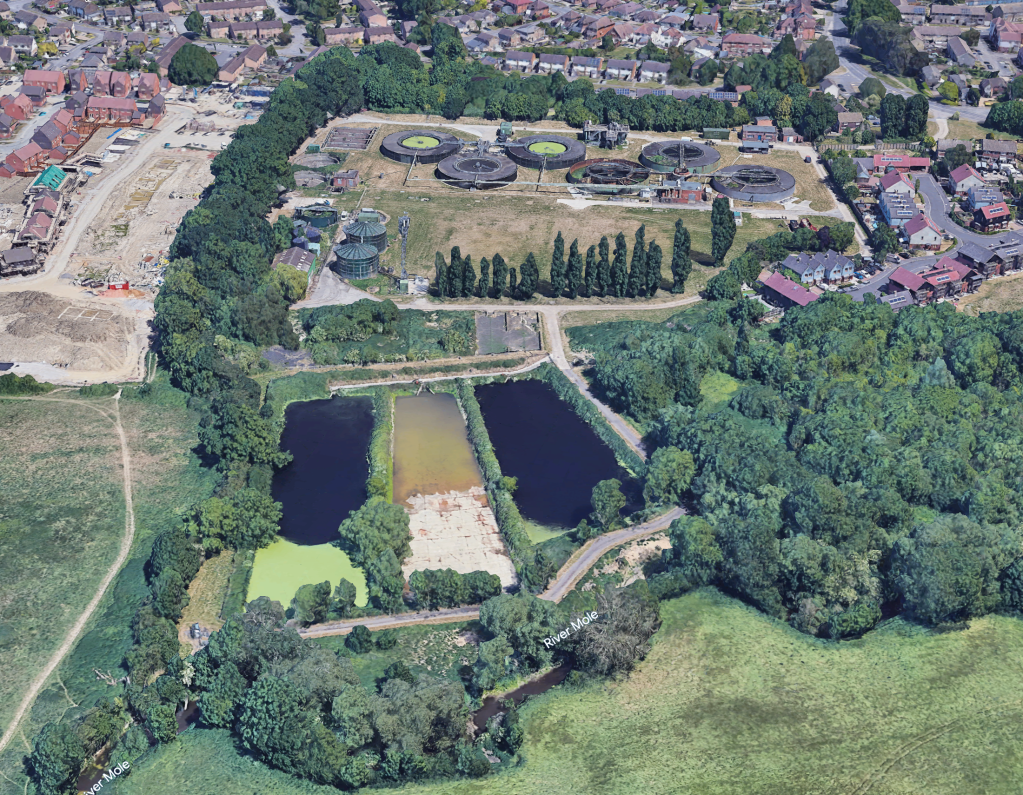
However, for the upcoming price review, Ofwat is encouraging companies to use technology and data to improve sewer system performance. Companies are regulated to construct and maintain sewerage networks using “Best technical Knowledge Not Entailing Excessive Cost” (BTKNEEC). In this case, AI and computer controlled infrastructure monitoring leading to a network of smart sewers could be a major step in identifying issues and improving sewer systems.
Modify and Modernise the Sewer System : There are 600,000km of drains and sewers. Separating rainwater from the waste water sewer network would be a mammoth task and cost between £350 and £600 billion. Not surprising then, that this option did not form part of the Government plan to reduce sewage overflows as it would add to customer bills.
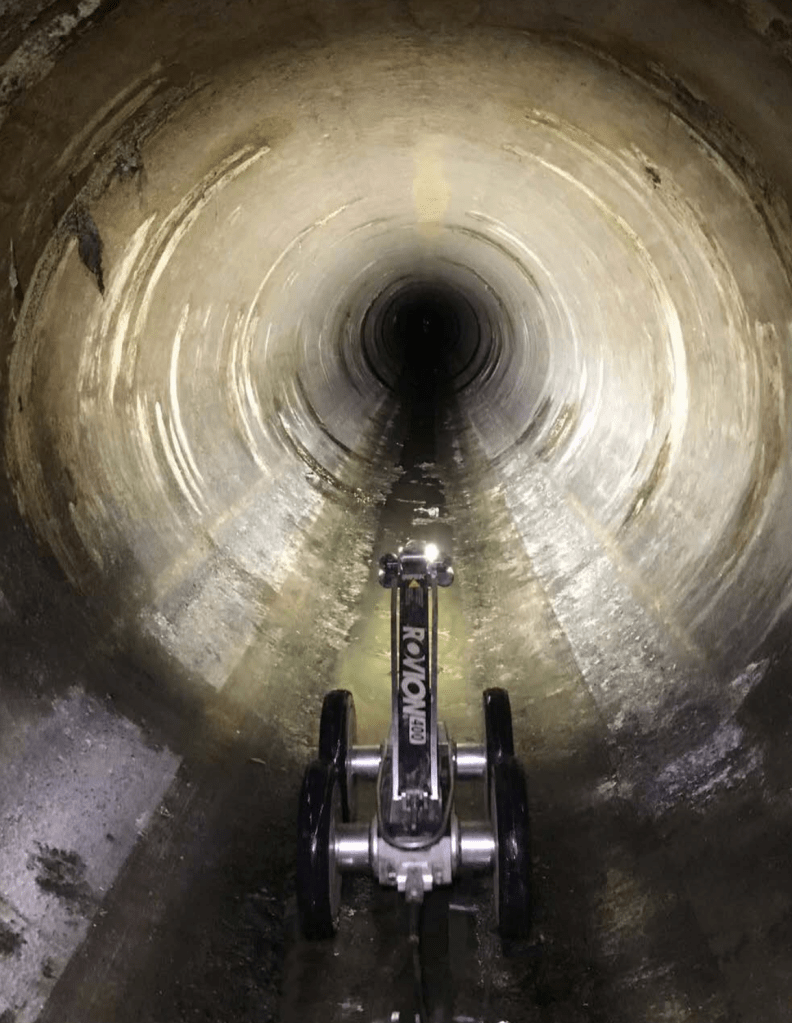
However, modernising sewers is a different story and is gathering pace with the introduction of advanced technology and monitoring allowing “smart sewers” to be controlled by AI. This intimate management of waste streams should permit companies to fine tune their resources to avoid pollution.
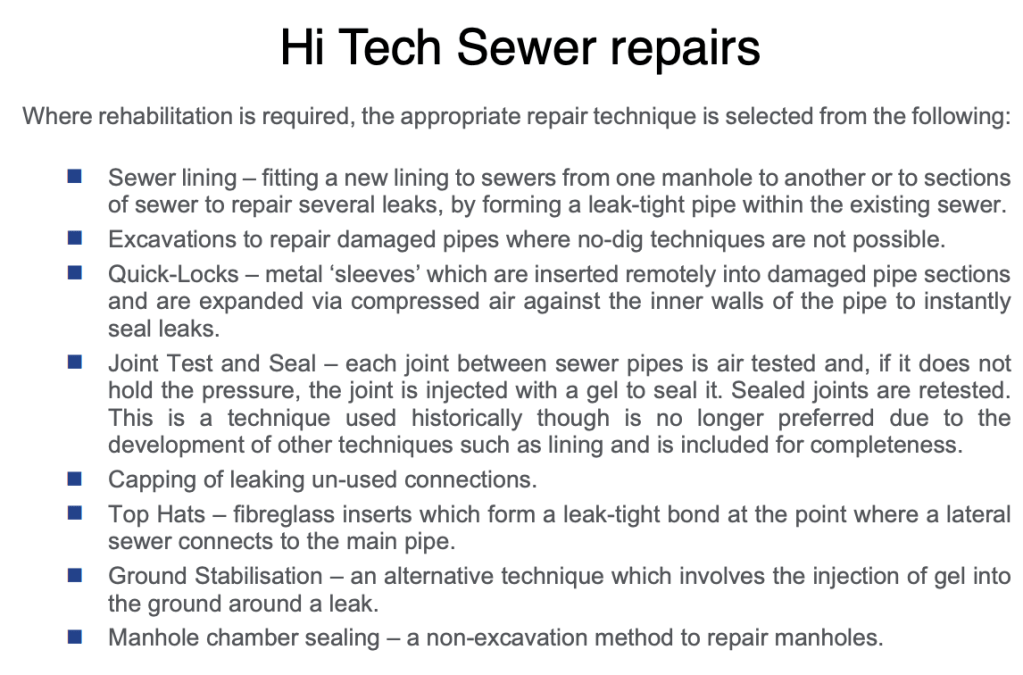
Manage storm runoff : Nature-based solutions such as Sustainable Urban Drainage, or SuDS, “spongify” new developments to hold back rain water runoff and delay or prevent its entry into sewers. This takes pressure off treatment works capacity, reducing storm overflows and hydraulic sewer flooding and often has the additional benefit of biodiversity gain. So this should be a win-win! Happily, SuDS were made mandatory for developers last year so there is progress on this front.
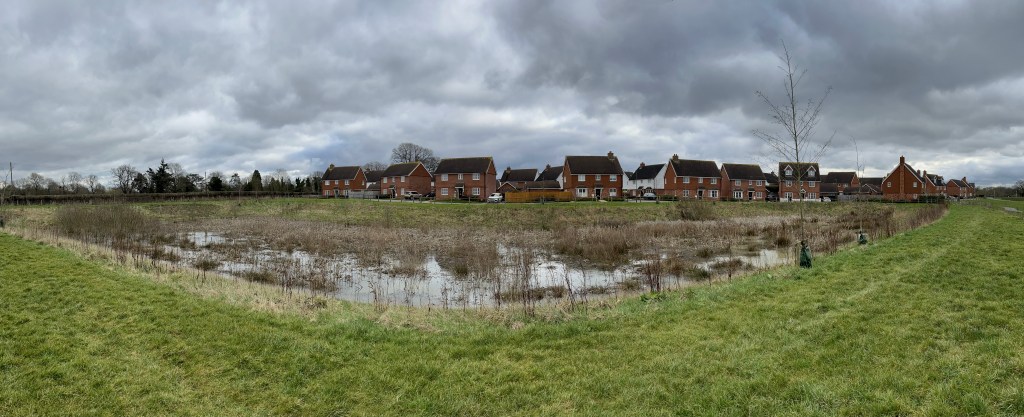
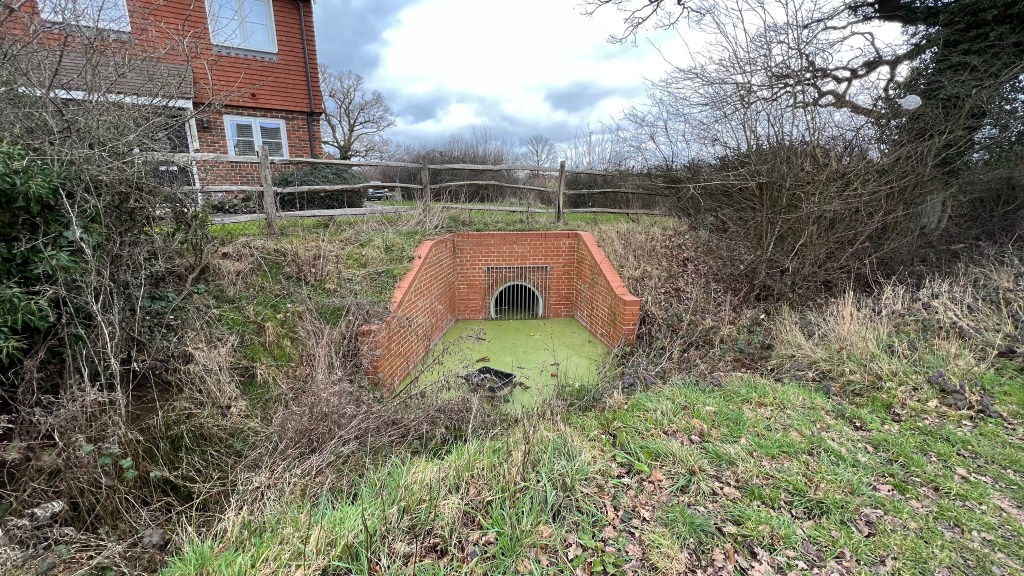
However, on a recent visit to a fairly new local development I noticed blocked culverts and poorly maintained, overgrown SuDS. To work properly developers and Local Authorities need to include regular maintenance of SuDS in planning applications or the retention capacity of SuDS will be rapidly impaired over time and might even cause more flooding.
Cease the right to connect! Enacting Schedule 3 of the Flood and Water Management Act 2010 would cease the automatic and unchallengeable right for new developments to connect to the sewer network. While SuDS have recently been made mandatory as part of the planning and development process it also essential the Water Companies have the right to turn down connections if local treatment capacity is exceeded.
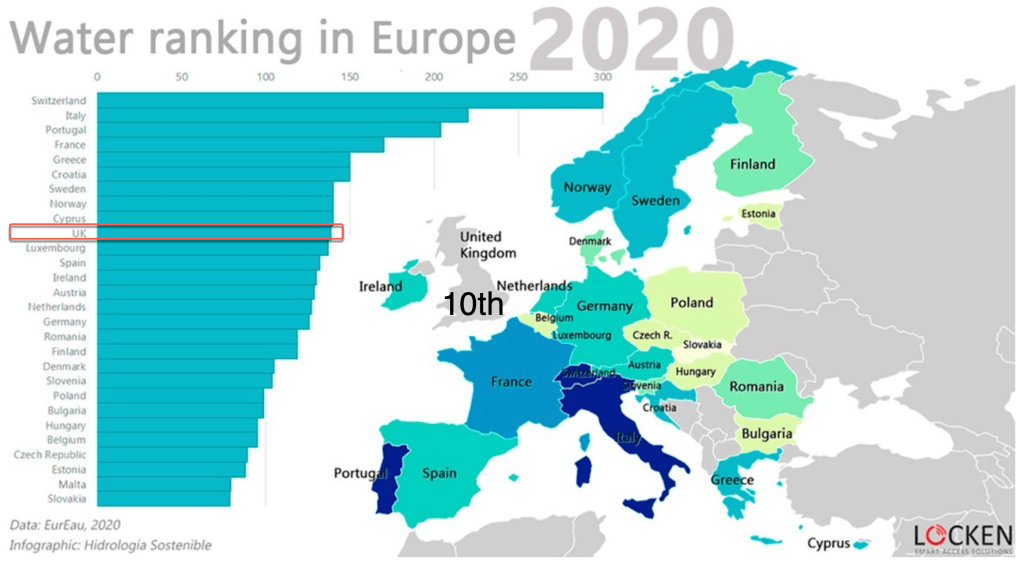
Change customer behaviour! This is a big one and grossly unrepresented in the media as it is brings home river pollution to us, our behaviour as individual consumers! Despite our temperate climate, UK households consume on average over 140 litres per person per day, in our region in the South East that goes up to 150 litres per person per day! Reducing our prodigious consumption of water would immediately reduce pressure on water treatment works. If consumer trends stay the same there will be a shortage of 3,435 million litres water per day by 2050. At least one third of the gap in water supply by mid-century must be filled by a change in consumer behaviour. In addition, changing consumer behaviour by making un-flushable products unacceptable would immediately reduce blockages, a major cause of hydraulic sewer overloading and pollution. The Lords have repeated the call for a ban on wet wipes! The education of consumers is one of the least well advanced solutions with only 64% of people polled understanding that their behaviour impacts river pollution.
Open Data! Related to the above is the provision of open data and transparent information to communities. Thames Water have made an excellent start with their EDM map which has provided community groups with much needed data to understand the progress being made, or otherwise.
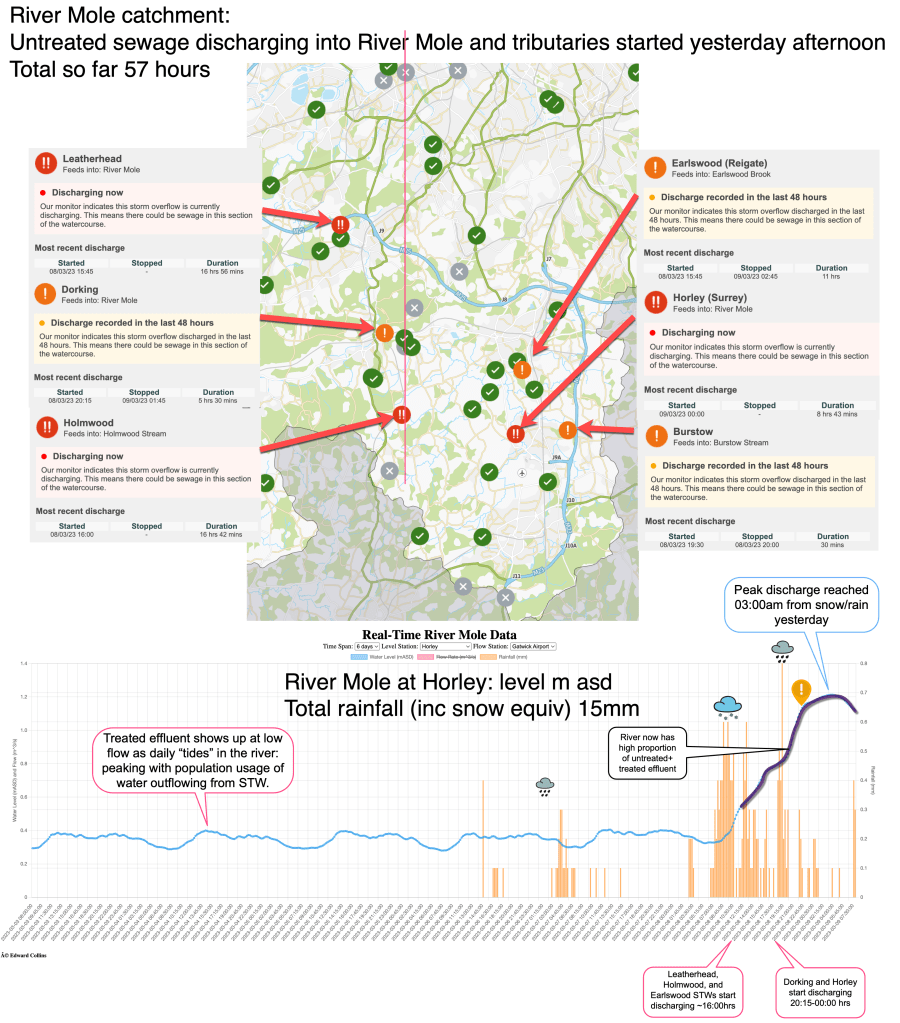
All water companies should commit to providing public, open data in a useable form on the environmental performance of their sewerage network and sewage works. Customers should be able to see how water companies are affecting their areas in real or near-real time, and regulators should have access to this information in order to ensure that water companies are fulfilling their duties.
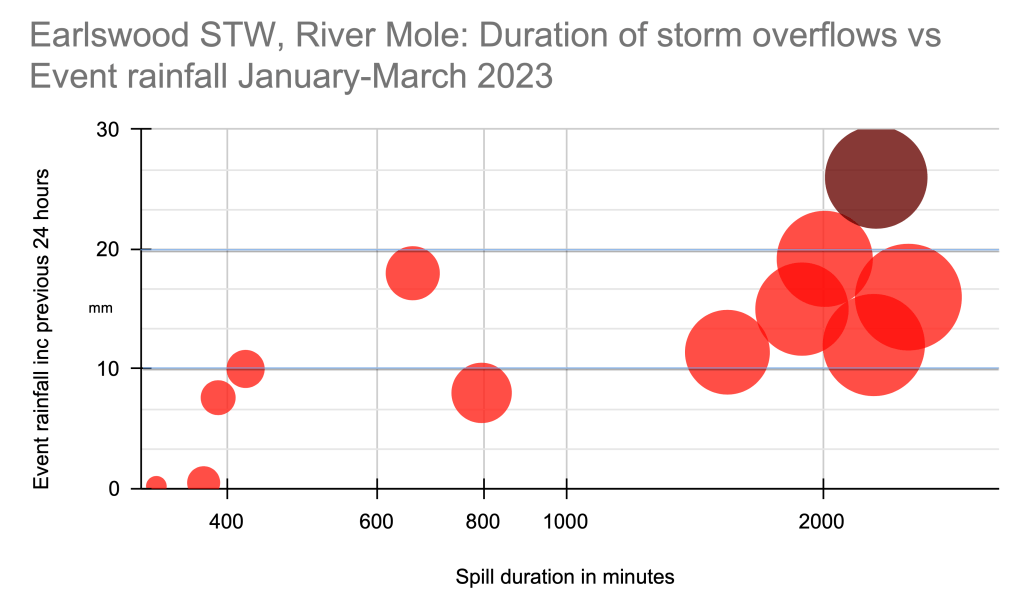
It is welcome the Environment Act 2021 amended the Water Industry Act 1991 to require companies to provide open data.

Encourage innovative approaches! Linked to SuDS, Nature Based solutions go further by enhancing the environment more widely while mitigating pollution. Examples include wetlands and reed beds that attract wildlife but also naturally filter polluted water and also retain it to reduce flooding into sewers and overloading of the sewer system in high rainfall episodes. In some ways they are closely relatives to Natural Flood Management schemes. Uncropped arable land and permeable woody barriers in water courses can slow the flow and reduce pressure on sewers. Nature Based Solutions also sequester carbon! There are very few draw backs. However, catchment and nature based solutions require a move from the 5 year price review system to longer term outcomes based regulation to incentivise companies to adopt long term innovation. Concrete and steel solutions will remain attractive as they are often quicker than nature based solutions to deliver desired outcomes.
The Government Plan

The Government “Storm Overflow Reduction Plan” is estimated to cost £56 billion over 25 years. It has set two broad targets:
- By 2035 water companies will have to improve all storm overflows discharging into or near designated bathing water sites (there is only one such site on a river in England!), and improve 75 per cent of overflows discharging to high priority nature sites for example SACs or SSSIs.
- By 2050 no storm overflows will be permitted to operate outside of unusually heavy rainfall or to cause any adverse ecological harm. This will apply to all remaining storm overflows covered by the targets, regardless of location.
The plan will be reviewed in 2027 when the Lords would like the Government to increase the ambition. Some Water Companies complain the Government targets are too slow. Thames Water, for example, has set it’s own targets several years earlier than the government plan.
The criticism of the the Government plan is that the targets are not sufficiently ambitious. Perhaps more importantly, the plan does not address the management of surface water drainage or adopt an holistic catchment based approach and so misses the opportunity for an holistic approach to solving the pollution problem.
Many Water Companies are going faster stating the Government plan is “too little too late”. For example, Sarah Bentley, Chief Executive of Thames Water, said that the current estimate for Thames Water is that they can make the necessary reductions in storm overflows by 2030 at a cost of £2 billion, as the company is advantaged by the Thames Tideway project resolving a large part of London’s infrastructure.

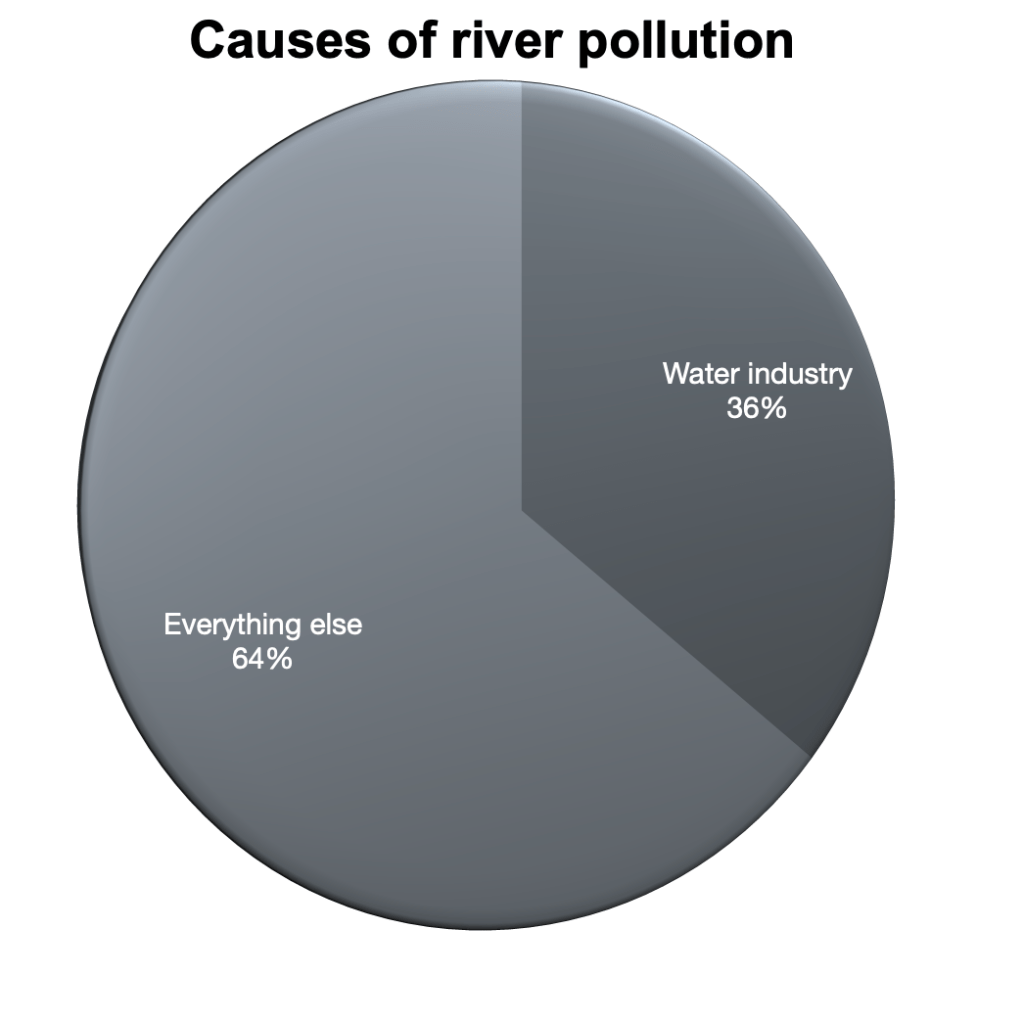
Unfortunately, pollution of rivers by the water industry as a whole forms just 36% of pollution in rivers. Furthermore, EA data suggests storm overflows are only 4% of the damage to river health. So, while tackling storm overflows is important, it will sadly not restore river health by itself. The Lords asked “is prioritising storm overflows best value for money?” Other measures mentioned so far, like changing consumer behaviour is an absolutely vital part of the whole picture to improve river health.

In addition, other major causes of pollution such as agriculture, road runoff, misconnections and the all pervasive and bioaccumulating “forever chemicals” need to be urgently addressed alongside storm overflows.

Future Water Supply
In 20 years there will not be enough water for the country. Demand will exceed supply particularly in areas that are already water stressed, such as the South East of England. Addressing solutions to this looming crisis must go hand in hand with improving river health. While building more storage and lowering customer demand are two potential opportunities to secure future supply, an holistic approach to water management on a catchment level is required if pollution is to be addressed.
Taking one water company as an example, Sutton and East Surrey Water (SESW) provides water to the bulk of the Mole Catchment (excluding Crawley). It supplies 745,000 people living in 300,000 properties. 85% of the water supplied is abstracted from boreholes in the Chalk and Greensand aquifers. 15% of SESW supply is imported from Bough Beech reservoir, outside the Mole Catchment, which is supplied by abstracting water from the upper reaches of the River Medway.
The company supplies 160 million litres per day, at an average per capita consumption of 151 litres per person per day (above the UK average). The Government target is to reduce consumption to 110 litres per day by 2050, this alone is crucial to the future of sustainable water supply in our area.
Climate change and population growth are set to increase demand and impact supply. Taking this into account, SESW expect to have a surplus of water until 2048 but thereafter demand is set to exceed available supplies. From this point our area will be in increasing water deficit.

SESW have estimated that without carrying out additional actions to reduce consumption or leakage, demand in a dry year will reach an average of around 210 million litres a day by 2080. At the same time, water supply is expected to decrease slightly, due to climate change, to around 190 million litres a day.
In SESW area: by 2075 there will be a shortfall of 46.7Ml/d, or 26.2% of what is needed.
https://seswater.co.uk/about-us/publications/our-water-resources-management-plan
So, there is no question that large scale options are required to bridge the gap between supply and demand by mid-century, only 20 years away.
Options included in Water Company future plans to address this looming crisis include the following:
- Desalinisation
- Leakage reduction: SESW plan to reduce leaks by 46% by 2045 on 2020 levels.
- Water Metering: SESW increase metering from 90% to 95% of customers by 2030 (smart meters to 10% by 2025.
- Reduce customer consumption: from 151 litres per day now, to 134 litres per person per day by 2025 to 118 litres per person per day by 2050.
- Reduce customer consumption: from 151 litres per day now, to 134 litres per person per day by 2025 to 118 litres per person per day by 2050.
- Water transfers between companies around the region e.g SESW plan to transfer water to South East Water as one of the six new transfer schemes in the South East to be finished around 2040.
- Water transfers from other regions e.g from Midlands and NW to SE using Grand Union Canal.
- Additional storage reservoirs: to avoid serious risk of drought more than £20 billon is needed to build new reservoirs; these would reduce drought restrictions
- Drought interventions
Between 2025 and 2035 the Water Resources SE draft plan identifies the need to:
- Complete the construction of one new reservoir in Hampshire and start building three more in Oxfordshire, Kent and West Sussex
- Use the Grand Union Canal to transfer water from the Midlands to South East England
- Develop six water recycling schemes in Kent, Sussex, London, Hampshire and the Isle of Wight to supplement our water supplies
- Build one desalination plant in Sussex.
Between 2035 and 2075 the WRSE draft plan proposes we:
- Develop a further six water recycling schemes across the region
- Transfer more water from the Midlands and the North West using the River Severn and the River Thames
- Build desalination plants in five locations in Kent
- Build one new reservoir in East Sussex
- Store extra water underground at three sites.
The impact of these proposals on supply is shown in the diagram below.
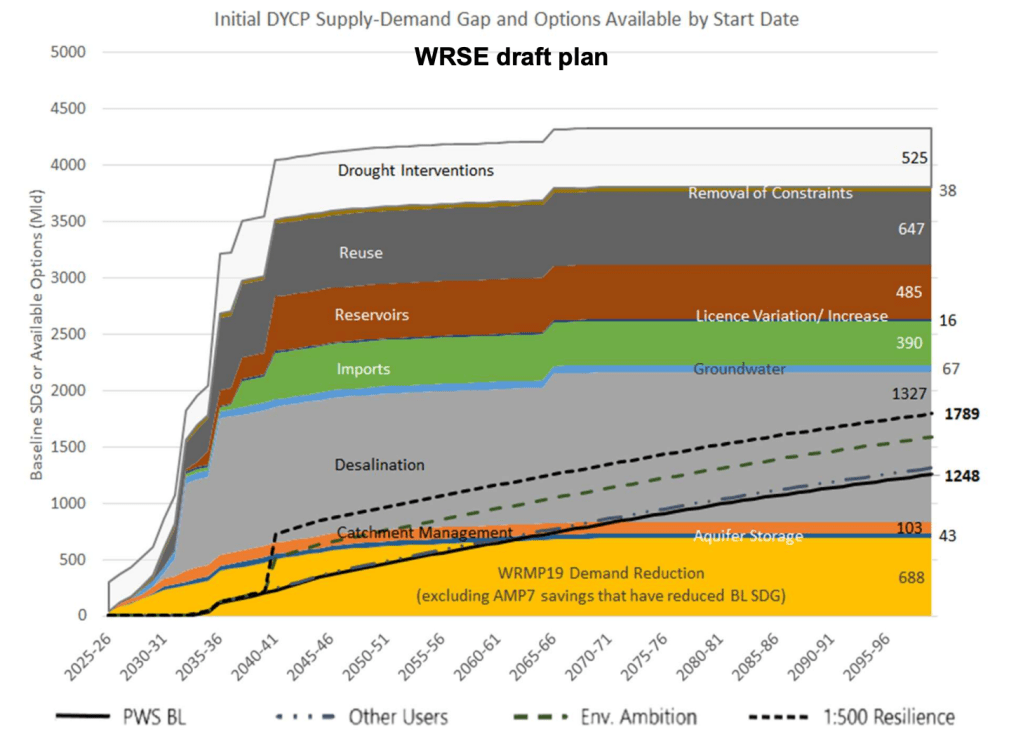
The figure shows the amount of water that could be saved, imported or generated within our region through different types of options. The dotted and dashed lines show how much water will be required in the future. Each type of option provides different benefits, will cost a different amount and take a different length of time to develop. What this shows is that we have a number of options in the South East to meet the anticipated future challenges, including the needs of other water users, increased environmental ambition and the extra water needed to achieve 1 in 500-year resilience to drought.
Part of the solution is to reduce consumption of water. This means changing consumer behaviour. This is the target where least progress is being made. If consumer trends stay same there will be a national shortage of 3.5 million litres water per day by 2050. 1/3 of this deficit must be filled by changing consumer behaviour. Studies have found that meters reduce consumption by 22% after the fourth bill!

Leaks
Leaks are a problem but Water Companies are slowly getting on top of these and meeting targets. It is important that companies model a proactive reduction in wasting water so that they can make better progress reducing customer demand.
Our local water supply company SESW, loses 21 million litres per day of clean water from leaks on their network. The EA has set companies a target to reduce leaks by 50% by 2050 from 2020 levels. Many water companies are meeting interim targets but, while 51 litres per person per day is leaked, the willingness of customers to reduce their own consumption will be reduced.

Final thoughts

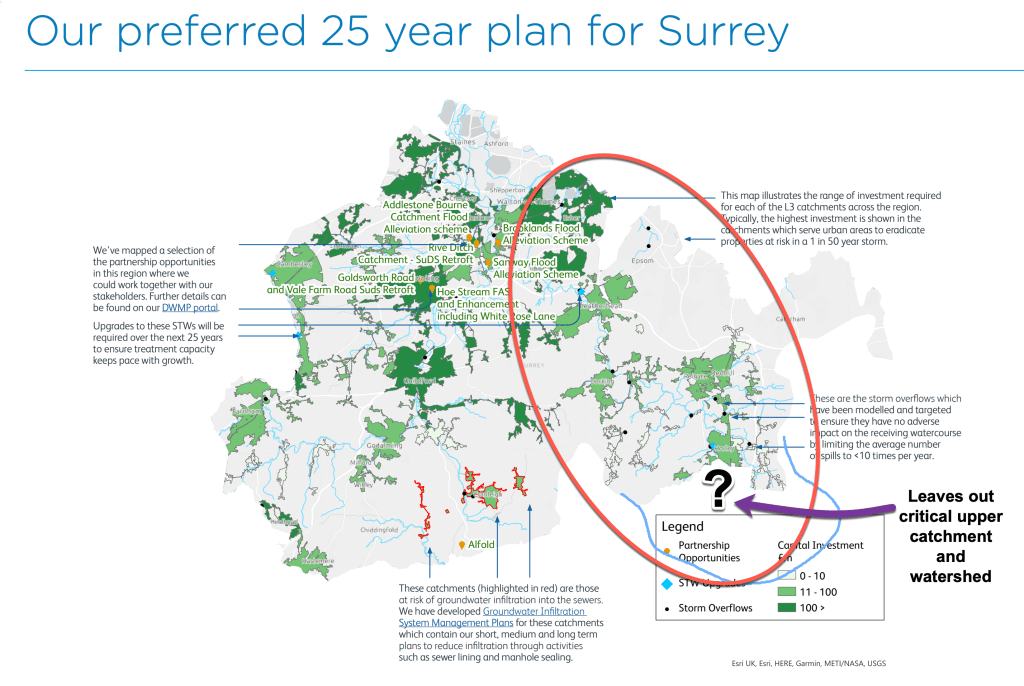
We mentioned holistic approaches as being central to solving river pollution. A problem with Thames Water drainage and waste water future plan is that it does not appear to have adopted an holistic catchment based approach. Indeed, TW seem to have sliced and diced catchments so that different parts of one catchments appear in geographically and hydrologically separated basins.
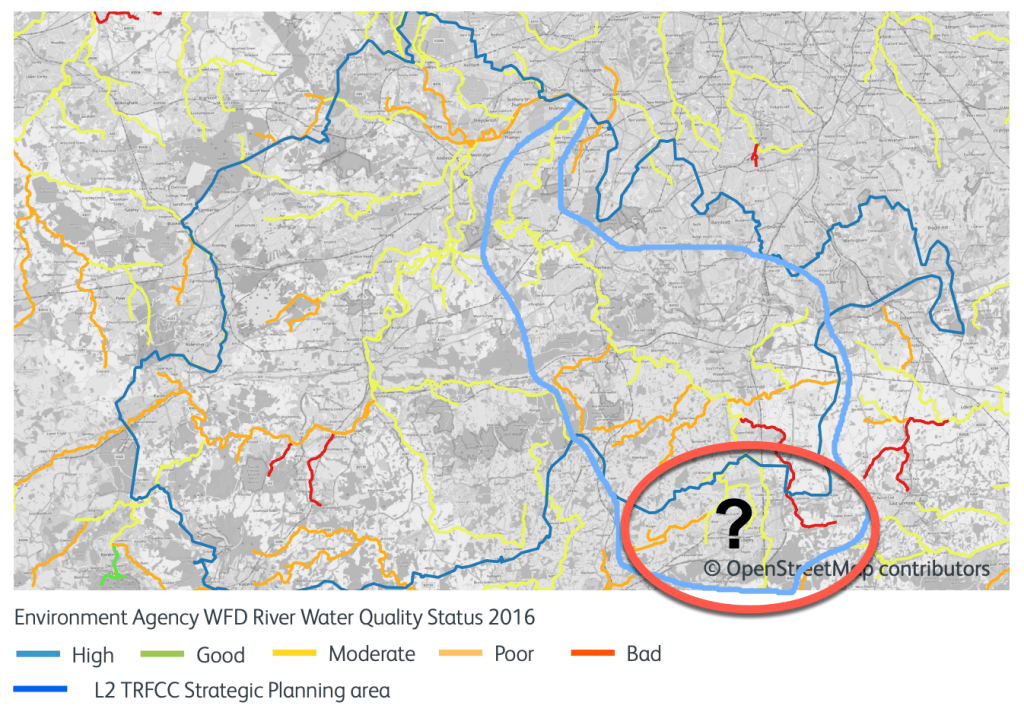
For example, the Mole catchment has been sliced up and the crucial southerly watershed appears to be part of the strategy for Reading and Berkshire.The Mole basin appears to have been sliced in half, not conducive to an holistic approach. By contrast, EA operate catchment officers are focussed on particular river basins. Achieving a joined up approach within catchments and to facilitate operating in conjunction with regulators is central to successfully tackling river basin problems… after all, rivers start a the source and finish at the end of the basin flowing through a myriad of habitats, towns, farms, treatment works and flood defences: all of these knock one onto the next. So it seems the 25 year plan for Surrey has missed a step towards an holistic approach joining up with regulators within at least one catchment.
To finish, in my view, the central message of the Lords committee report is that the Government need now to urgently produce a National Water Strategy that promotes an holistic approach to solving river pollution and providing a secure water supply sustainably into the future.

References
House of Lords Report: Industry and Regulators Committee “The affluent and the effluent: cleaning up failures in water and sewage regulation” 1st Report of Session 2022-23 – published 22 March 2023 – HL Paper 166
Sutton East Surrey Water Company https://seswater.co.uk/about-us/publications/our-water-resources-management-plan
Water Resources South East securing water supplies for generations
Working towards a CSO-free future: Adler and Allen
Thames Water drainage and wastewater management plan https://www.thameswater.co.uk/about-us/regulation/drainage-and-wastewater-management#csplans
Water and Sewerage Company Gov report 2019 https://www.gov.uk/government/publications/water-and-sewerage-companies-in-england-environmental-performance-report-2019/water-and-sewerage-companies-in-england-environmental-performance-report-for-2019
Government Storm Overflows Reduction Plan 2022:
https://www.wessexwater.co.uk/services/sewerage/storm-overflows
 The Mole Story
Leave a comment